
10 Signs Your Business Is Ready for RFID Automation

Updated: Aug 17
Every day, warehouse managers across India watch their teams manually scan barcodes, reconcile inventory mismatches, and hunt down misplaced assets, hours lost to tasks that technology solved a decade ago. If this sounds familiar, your business may already be ready for RFID automation.
RFID (Radio Frequency Identification) is a technology that uses radio waves to identify and track tags attached to objects automatically. Unlike traditional barcode systems that require line-of-sight and manual scanning, RFID reads multiple items simultaneously in real time, at a distance, without human intervention. Industrial automation in India is accelerating, and RFID is at the centre of it.
But how do you know when it's the right time to make the switch? Here are 10 clear signs your business is ready for RFID automation.
What Is RFID Automation?
RFID automation is the use of RFID tags, readers, and software to automatically capture, track, and manage the movement of assets, inventory, or vehicles without manual scanning or physical contact. Each RFID tag carries a unique ID that is read instantly as it passes within range of a reader antenna.
Unlike barcodes, which require a scanner operator and clear visibility, RFID systems can read hundreds of tags per second, even through packaging, boxes, or pallets. This makes RFID asset tracking one of the most powerful tools available for Indian businesses dealing with high-volume inventory, complex supply chains, or multi-location operations.
10 Signs Your Business Is Ready for RFID Automation
1. Your Inventory Counts Are Frequently Wrong
If cycle counts reveal regular discrepancies between system records and physical stock, manual processes are failing you. Barcode-based systems are only as accurate as the human scanning them. RFID reads inventory automatically and continuously, eliminating human error and delivering near-perfect stock accuracy, often reducing discrepancy rates by up to 99%.
2. You're Losing Track of High-Value Assets
Machinery, tools, IT equipment, pallets, and containers disappear inside large facilities every day. If your team wastes time searching for assets or writing off losses you can't explain, RFID asset tracking is the direct solution. Every tagged item is location-visible in real time, without someone needing to physically find and scan it.
3. Your Warehouse Operations Depend Too Much on Manual Labour
If receiving, put-away, picking, and dispatch all rely on people physically scanning individual items, you have a significant labour dependency and a significant bottleneck. Warehouse automation using RFID replaces repetitive scan-by-scan processes with automatic data capture at dock doors, conveyor belts, and storage zones. The result: faster throughput, fewer staff deployed on low-value tasks, and lower operational costs.
4. Your Production Line Has No Real-Time Traceability
In manufacturing, knowing exactly where each component or work-in-progress item is at any moment isn't optional; it's essential for quality control, compliance, and delivery accuracy. If your production team relies on paper-based tracking or end-of-shift data entry, you have a traceability gap. RFID provides a live, automated audit trail from raw material receipt to finished goods dispatch.
5. You're Dealing With Frequent Shipment Errors
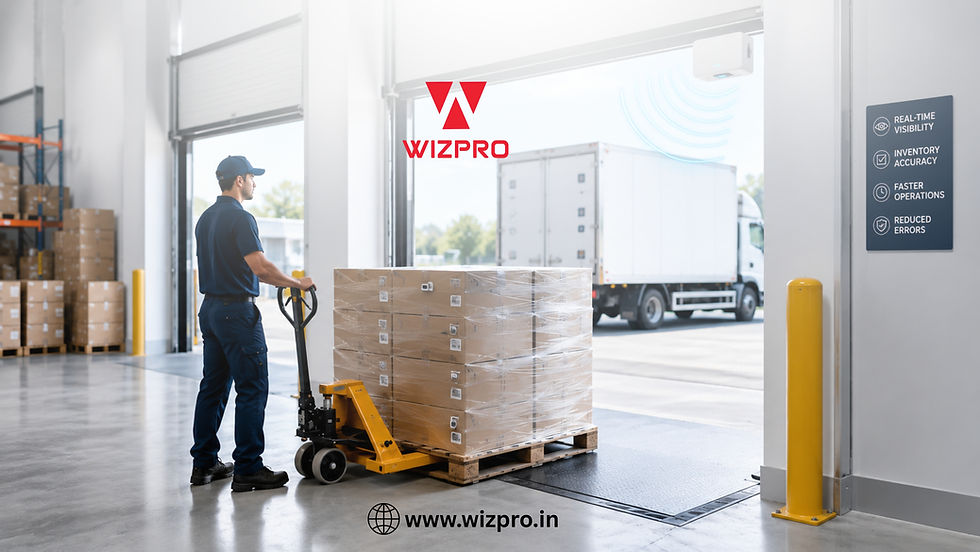
Shipping the wrong product, the wrong quantity, or to the wrong location is expensive in returns, customer complaints, and reputation damage. If your dispatch team relies on manual verification, errors are inevitable. RFID-enabled loading docks automatically verify every item leaving the facility against the outbound order, flagging discrepancies before the truck leaves.
6. Barcode Processes Are Slowing You Down
If your team regularly faces issues with damaged barcodes, poor print quality, or time-consuming one-by-one scanning, you've outgrown barcode technology. The barcode vs RFID comparison is clear for high-volume operations: RFID reads hundreds of items simultaneously with zero line-of-sight requirement and far greater read reliability. Upgrading is not just an efficiency gain it's a competitive necessity.
7. You Operate Across Multiple Locations or Warehouses
Managing stock movements across factories, warehouses, distribution centres, or retail outlets with manual processes creates data silos and reconciliation nightmares. RFID integrates with ERP and WMS systems to give you a single, unified, real-time view of inventory and asset positions across every location, eliminating the coordination overhead that manual systems create.
8. Compliance and Audit Readiness Is a Challenge
Regulated industries – pharmaceuticals, food processing, and electronics require full traceability and documentation at every step. If preparing for an audit means a week of data consolidation, your current system is a liability. RFID automatically generates an accurate, time-stamped digital record of every movement, making compliance a continuous process rather than a fire drill.
9. You're Seeing High Shrinkage or Theft
Unexplained inventory loss, whether from theft, misplacement, or administrative error, is a direct hit to your bottom line. RFID creates an automatic checkpoint at every entry and exit point, triggering alerts when tagged items move without authorisation. IoT-based automation in India increasingly incorporates RFID-driven security perimeters as standard practice in warehousing and manufacturing.
10. You're Planning to Scale Operations
If your business is growing, adding SKUs, expanding warehouse space, increasing order volume, or entering new markets, scaling manual processes means hiring proportionally more staff. RFID scales differently: the system handles greater volume with no corresponding increase in headcount. If growth is on your roadmap, now is the right time to build RFID infrastructure that will support it.
Industries Where RFID Automation Delivers the Most Value
RFID is not a one-size-fits-all technology, but it delivers measurable ROI across a wide range of sectors:
Manufacturing component tracking, WIP monitoring, finished goods traceability, and defect reduction through automated identification at every production stage.
Warehousing & Logistics: Inbound receiving, storage location management, order picking accuracy, and outbound shipment verification.
Highways & Toll Infrastructure: Vehicle identification, toll collection, and traffic flow management using RFID tags for fast-lane processing.
Smart Cities & Government Projects: Asset management, access control, and supply chain transparency for large-scale infrastructure programmes.
Retail & apparel item-level: inventory accuracy, loss prevention, and omnichannel fulfilment support.
Pharmaceuticals & Food: Batch traceability, cold chain monitoring, and regulatory compliance documentation.
Common RFID Automation Mistakes
Even businesses that invest in RFID can lose value if implementation is not planned properly. Common mistakes include:
Skipping the site survey: Metal, liquids, and layout can affect RFID performance and cause read issues.
Choosing the wrong tags: Select tags based on the application, environment, and read range, not just price.
Ignoring ERP/WMS integration: RFID data should connect with existing systems to provide useful, real-time visibility.
Underestimating staff training: Employees need proper training and updated processes for successful adoption.
Automating everything at once: Start with a high-priority process, prove ROI, and then scale gradually
Conclusion:
Every month without RFID automation is another month of inventory errors, asset losses, labour inefficiencies, and missed throughput. Industrial automation in India is no longer a competitive advantage; it's a baseline expectation for businesses that want to grow.
The 10 signs above are not warnings about future risk. For most businesses, they are present-day realities. The question is not whether to automate; it's how quickly you move.
Ready to Know If RFID Is Right for Your Business?
Wizpro specialises in end-to-end RFID automation solutions across India.
Talk to our experts. Know your numbers. Automate with confidence.
Frequently Asked Questions
1. What is RFID automation and how does it differ from barcode scanning?
RFID automation uses radio frequency signals to automatically identify and track tagged items without manual scanning or line-of-sight. Unlike barcodes, RFID reads multiple items simultaneously and works even when tags are hidden inside packaging, making it significantly faster and more accurate for high-volume operations.
2. How much does RFID automation cost for a warehouse in India?
RFID implementation costs vary based on facility size, number of tags, reader infrastructure, and software integration requirements. However, most Wizpro clients see full return on investment within 6–12 months through reduced inventory errors, faster throughput, and lower labour dependency. A site-specific assessment provides an accurate cost and ROI projection.
3. Is RFID suitable for small and mid-sized businesses in India or only for large enterprises?
RFID is increasingly accessible for mid-market businesses. If you're managing more than 500 SKUs or assets, operating across more than one location, or experiencing regular inventory discrepancies, RFID delivers ROI at your scale. A phased implementation approach makes it financially manageable for growing businesses.
4. What industries benefit most from RFID asset tracking in India?
Manufacturing, warehousing and logistics, pharmaceuticals, food processing, retail, and highway and toll infrastructure are the primary sectors. Any operation that requires real-time visibility, traceability, or accurate inventory management across multiple points can benefit from RFID automation.
5. How long does an RFID automation implementation take? A focused RFID deployment for a single warehouse zone or production line can go live in 4–8 weeks. Larger, multi-site implementations typically take 3–6 months. The timeline depends on infrastructure complexity, software integration scope, and the number of tagged items. Wizpro manages the full implementation lifecycle, from site survey to staff training and go-live.


Comments