
How Machine Vision Reduces Defect Costs in Automotive Manufacturing

Updated: Jun 5
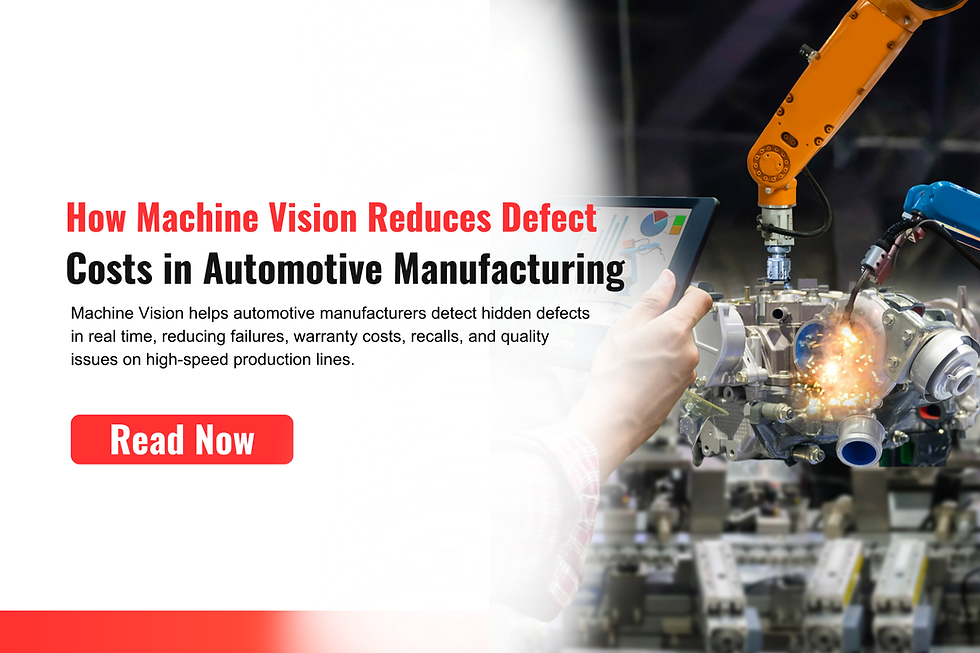
In automotive manufacturing, the biggest problems are often the defects that are not noticed during production. Small issues like a missing bolt, uneven glue application, wrong assembly sequence, or tiny surface damage can later cause product failures, customer complaints, warranty costs, recalls, and delays.
Today, the Indian automotive industry is becoming more automated, and quality standards are increasing globally. Because production lines are running faster than ever, manual inspection is becoming difficult to manage. This is where machine vision systems help improve quality control.
Why Manual Inspection Is Not Enough
Modern automotive production lines work at very high speeds. Human inspectors have to check many components continuously and identify even very small defects. Over long working hours, tiredness, inconsistent judgement, and human limitations can cause mistakes and missed defects.
Common challenges with manual inspection include:
Missed micro-defects
Inconsistent shift-wise inspection quality
Slow inspection cycles
Higher rework and scrap costs
Limited traceability
A single unnoticed defect can interrupt the entire supply chain.
What Is a Machine Vision System?
A machine vision system uses industrial cameras, AI-powered software, lighting systems, and automation controllers to inspect products in real time.
Unlike manual inspection, machine vision delivers:
Continuous 24/7 inspection
Consistent accuracy
Fast image processing for production lines
Real-time defect detection
Instant inspection alerts
These systems can instantly identify defects, verify assembly sequences, measure dimensions, read labels, and trigger corrective actions without slowing production.
Here are a few examples where machine vision creates the biggest impact:
1. Assembly Verification
Automotive components often require strict assembly sequences. Missing or incorrectly tightened fasteners can create major safety risks.
Machine vision systems verify the following:
Nut and bolt positioning
Correct tightening sequence
Component presence/absence
Part orientation
This eliminates assembly errors before products move to the next stage.
2. Sealant Inspection
Modern vehicles rely heavily on adhesives for structural strength and sealing. Using advanced lighting and AI imaging, machine vision systems detect the following:
Incomplete adhesive paths
Glue gaps
Uneven bead width
Sealant discontinuity
High-precision defect detection
3. Surface Defect Detection
Paint imperfections, scratches, dents, and cracks are difficult to identify consistently through manual inspection. AI-powered machine vision systems can inspect the following:
Painted surfaces
Metal components
Machined parts
Reflective materials
This improves finish quality while reducing customer complaints.
4. OCR and Traceability
Automotive manufacturing depends heavily on traceability.
Machine vision systems can accurately read the following:
Serial numbers
QR codes
Batch codes
Labels
This ensures complete production tracking and compliance.
AI-Powered Inspection vs Traditional Rule-Based Systems
Traditional vision systems rely on fixed rules and measurements. While effective for dimensional inspection, they struggle with unpredictable defects.
Modern AI-based machine vision uses deep learning models trained on real production defects. These systems continuously improve detection accuracy for: Surface anomalies, Irregular textures, Weld inconsistencies, Defect classification, OCR recognition, The result is faster and more reliable inspection with fewer false rejects.
Real-Time PLC Integration
A vision system becomes truly effective when integrated directly with production automation.
Machine vision systems communicate with PLCs in real time to:
Stop defective parts
Trigger rejection mechanisms
Send signals to PLCs and automation systems
Validate assembly sequences
Supports inspection traceability
This enables fully automated quality control without impacting cycle time.
Benefits of Machine Vision in Automotive Plants
Reduced Rework and Scrap
Early defect detection prevents defective components from moving downstream, reducing costly rework.
Higher Production Efficiency
Automated inspection keeps pace with high-speed production lines without slowing operations.
Improved Product Quality
Consistent inspection improves reliability and helps manufacturers meet OEM quality standards.
Better Traceability
Every inspection result is digitally recorded for audits, compliance, and quality analysis.
Lower Operational Costs
Reducing manpower dependency and defect leakage significantly lower long-term quality costs.
Industries Adopting Machine Vision Beyond automotive manufacturing,
Machine vision solutions are widely used in the following:
Electronics manufacturing
Pharma production
FMCG packaging
Metal and steel processing
Food manufacturing
Logistics and warehousing
The demand for intelligent inspection systems is growing rapidly across India.
Why Lighting Matters More Than the Camera
One of the biggest misconceptions in machine vision deployment is assuming the camera is the most important component.
In reality, proper illumination determines inspection success.
Different applications require different lighting techniques:
Ring lighting
Backlighting
Structured lighting
UV illumination
Dark-field lighting
Correct lighting makes defects clearly visible and improves AI accuracy dramatically.
The ROI of Machine Vision
For automotive manufacturers, the return on investment is often faster than expected.
Typical benefits include the following:
Reduced defect leakage
Lower warranty claims
Faster inspections
Reduced manual labor
Higher throughput
Better OEM compliance
Machine vision can significantly reduce long-term quality costs.
The Future of Automotive Quality Control
The automotive industry is rapidly moving from traditional inspection methods to smarter, AI-driven quality control systems. Manufacturers adopting
Machine vision technology is enabling better process control, real-time production visibility, lower defect rates, and stronger competitive advantages. As production lines become faster and quality standards become stricter, automated inspection is no longer just an option; it is becoming essential for modern manufacturing.
Conclusion
Defects that escape inspection are expensive. They create rework, warranty claims, downtime, and customer dissatisfaction.
Machine vision systems help automotive manufacturers detect issues instantly, automate quality control, and maintain consistent production standards at scale.
From assembly verification and adhesive inspection to OCR and AI-powered
With defect detection, machine vision is redefining modern manufacturing quality.
For manufacturers aiming to reduce hidden quality costs, improve efficiency, and achieve zero-defect production, investing in AI-powered machine vision is a strategic step toward smarter manufacturing. Boost quality and reduce defects with Wizpro’s AI-powered machine vision solutions for smarter manufacturing. Contact Now:
For More Details


Comments